AMP Bao Tutorial Example Design User Guide
Introduction
This page presents a couple of Bao hypervisor examples running on the Agilex™ 5 FPGA E-Series 013B Development Kit
Overview
Bao is an open-source static-partitioning hypervisor. It runs at EL2. A configuration file compiled into the hypervisor image assigns each guest its cores, its memory, and its devices, and the guest keeps that assignment for the life of the boot. Bao installs a stage-2 translation for each guest and a virtual GICv3 for the interrupts named in the configuration. Guests exchange data through a shared-memory region. A hypercall asks Bao to inject an interrupt into the peer guest.
The Agilex 5 port is the patch set in bao-hypervisor/patches/v2.0.0/. It adds the HPS platform, PSCI, virtual GICv3 integration, shareability for the IPC region, an SMMUv3 driver, and the cache-coloring fixes the hypervisor needs on this core. Coloring divides the 2 MiB L3 cache into 16 colors of 128 KiB. Each guest receives its own colors, so its cache lines stay in its own slice of the L3. Where coloring makes a guest intermediate address differ from the physical address, the SMMUv3 stage-2 translation keeps that guest's DMA masters on the guest's pages.
These examples build Bao from commit 0af4a1ab558ad60c9658af4f43756c4536dd3141 (the v2.0-rc7 tree, after the v2.0.0 tag). The upstream README describes Bao's configuration language and the upstream build. The rest of this page is how this example uses that language on the Agilex 5 HPS.
Prerequisites
The following are required to be able to fully exercise the Example Design:
- Altera® Agilex™ 5 FPGA E-Series 065A Premium Development Kit, ordering code DK-A5E065AB32AEA. Refer to board documentation for more information.
-
Host PC with:
- 64 GB of RAM. Less will be fine for only exercising the binaries, and not rebuilding the HPS Baseline System Example Design.
- Linux OS installed. Ubuntu 22.04LTS was used to create this page, other versions and distributions may work too
- Serial terminal (for example GtkTerm or Minicom on Linux and TeraTerm or PuTTY on Windows)
- Altera® Quartus® Prime Pro Edition Version 26.3
- Internet connection. For downloading the files, especially when rebuilding the HPS Baseline System Example Design.
Overview of the Examples
This page builds two asymmetric multi-processing configurations from software/amp_bao/ on the Agilex 5 FPGA E-Series 065A Premium Development Kit. Both use the Quartus project from the HPS Baseline System Example Design. U-Boot SPL is programmed into QSPI together with the FPGA bitstream. U-Boot, Bao, and the guest images are on the SD card. At boot, U-Boot runs boot.scr, which programs the fabric from fpga.rbf, enables the HPS-to-FPGA bridges, and jumps to Bao. The serial port is HPS UART0 at 115200 baud, 8 data bits, no parity, and 1 stop bit.
CONFIG |
Guests | What the console shows | SD card |
|---|---|---|---|
baremetal |
Two baremetal VMs on the Cortex-A55 cores | [VM1] IPI latency and [VM2] ILC latency on UART0 |
FAT only. Both guests are linked inside bao.bin. |
linux_freertos |
Linux on both Cortex-A76 cores, FreeRTOS on one Cortex-A55 | Linux login on UART0. FreeRTOS heartbeats and ILC lines on /dev/rpmsg0 |
FAT boot files and an ext4 Buildroot root filesystem. FreeRTOS is linked inside bao.bin. |
Run make CONFIG=<name> from software/amp_bao/. The orchestrator reads sources.yaml, clones each upstream tree, applies the patch directory named for that component, and builds the pieces that configuration uses. The first build downloads the Arm GNU toolchain 14.3.rel1 into software/amp_bao/.toolchain/.
Architecture
Baremetal guests
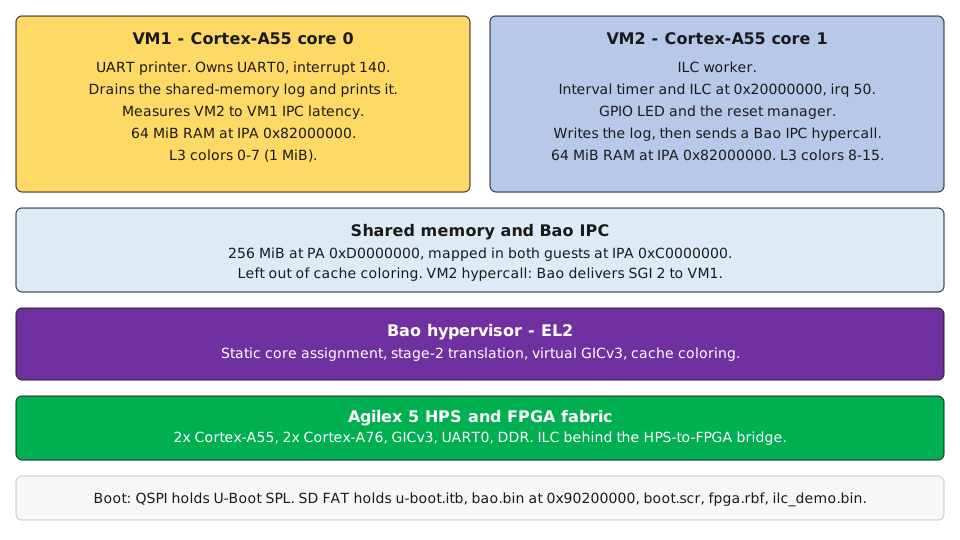
configs/baremetal/config.c is the manifest for this configuration. VM1 runs on Cortex-A55 core 0 and owns UART0, so it is the guest that prints. VM2 runs on Cortex-A55 core 1. It owns the fabric interval timer and the Interrupt Latency Counter (ILC) at 0x20000000, measures interrupt latency, and writes each result into the shared-memory log. VM2 then issues the Bao IPC hypercall. Bao delivers SGI 2 to VM1, and VM1 prints the line together with the VM2-to-VM1 latency. Those are the [VM1] IPI and [VM2] ILC lines in the run section below.
Both guests are linked into bao.bin. U-Boot loads that image at 0x90200000 and jumps there. Each guest executes at intermediate address 0x82000000 in 64 MiB of RAM. Bao backs the two ranges with different physical pages: VM1 uses L3 colors 0-7 (1 MiB) and VM2 shares colors 8-15 with Bao. The 256 MiB log buffer is pinned at physical address 0xD0000000 and mapped into both guests at 0xC0000000. That region is left uncolored, so both cores observe the same data.
ilc_demo.bin is copied to the FAT partition as its own file. boot.scr leaves it there. Loading it from the U-Boot prompt runs the same ILC measurement directly on the core. Compare that result with the [VM2] ILC lines to see the virtual-GIC overhead. The commands, including the entry point 0xA0000000, are in the standalone ILC README linked below.
The Cortex-A76 cores stay idle. Commented affinities in config.c move the two VMs onto those cores.
| Resource | VM1 | VM2 |
|---|---|---|
| CPU | Cortex-A55 core 0 | Cortex-A55 core 1 |
| RAM | 64 MiB at IPA 0x82000000 |
64 MiB at IPA 0x82000000 |
| L3 colors | 0-7 | 8-15, shared with Bao |
| Devices | UART0, interrupt 140 | Lightweight HPS-to-FPGA window 0x20000000 (ILC, interrupt 50), GPIO, reset manager |
| IPC | Receives SGI 2 | Sends the IPC hypercall |
| Image | Inside bao.bin, entry 0x82000000 |
Inside bao.bin, entry 0x82000000 |
configs/baremetal/config.mk sets AGX5_MEM_GB=2, BAO_LOAD_ADDR=0x90200000, and the shared-memory base. Keep config.c, config.mk, and configs/baremetal/boot.cmd on the same addresses.
Linux and FreeRTOS
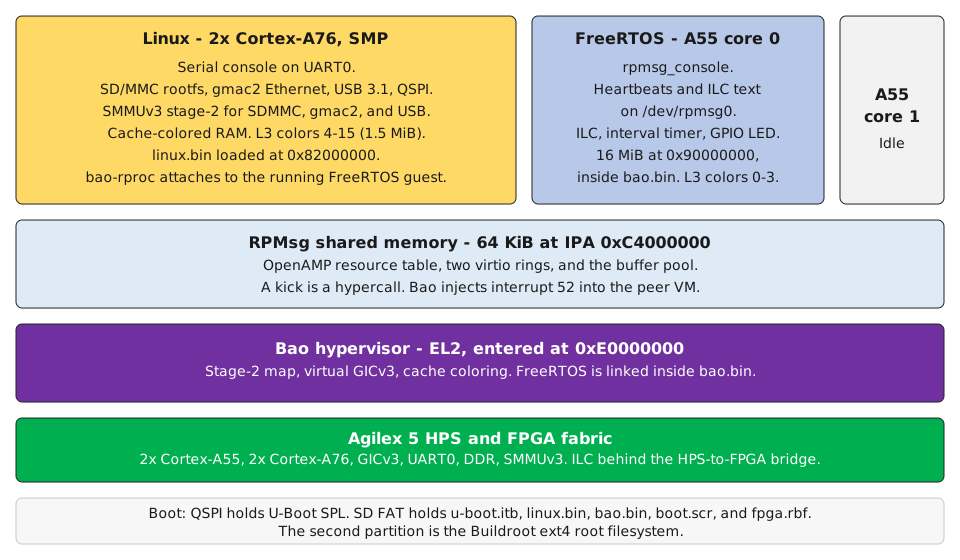
configs/linux_freertos/config.c assigns both Cortex-A76 cores to one Linux VM and Cortex-A55 core 0 to FreeRTOS. Cortex-A55 core 1 stays idle. Linux owns UART0, the SD/MMC controller, gmac2 Ethernet, USB 3.1, and QSPI. FreeRTOS runs rpmsg_console. Its heartbeat and ILC lines arrive in Linux on /dev/rpmsg0.
On this kit the Linux configuration sets AGX5_MEM_GB=8. Bao's platform pool is the low DDR window plus 6 GiB at 0x880000000. Linux receives 5 GiB of that pool: 1 GiB at IPA 0x82000000 and 4 GiB at IPA 0x880000000. FreeRTOS receives 16 MiB at IPA 0x90000000. The baremetal configuration on this kit keeps AGX5_MEM_GB=2.
U-Boot loads linux.bin at 0x82000000 and bao.bin at 0xE0000000, then jumps to Bao. linux.bin is the lloader stub, the kernel Image, and the guest device tree built from configs/linux_freertos/linux.dts. The stub hands that device tree to Linux. Bao starts FreeRTOS from the copy embedded in bao.bin and starts Linux at 0x82000000. By the time the login banner is printed, FreeRTOS is already running. echo start on remoteproc0 attaches the bao-rproc driver to that guest.
Linux uses L3 colors 4-15 (1.5 MiB). FreeRTOS and Bao share colors 0-3 (512 KiB), which keeps Bao's interrupt path in the same L3 slice as the real-time guest. Coloring makes the Linux intermediate address differ from the physical address, so Bao binds three SMMUv3 streams to the Linux stage-2 table: SDMMC (stream 5), gmac2 (stream 3), and USB 3 (stream 7). The smmuv3: stream N -> stage-2 lines in the boot log are those bindings.
The guests share 64 KiB at IPA 0xC4000000. FreeRTOS publishes the OpenAMP resource table at the start of that window.
| Offset | Size | Contents |
|---|---|---|
0x0000 |
1 KiB | OpenAMP resource table |
0x1000 |
8 KiB | Virtio ring, Linux to FreeRTOS |
0x3000 |
8 KiB | Virtio ring, FreeRTOS to Linux |
0x5000 |
16 KiB | Shared RPMsg buffers |
0x9000 |
Remainder of the 64 KiB | Reserved |
A kick is a hypercall into Bao. Bao injects interrupt 52 into the peer vCPU. In the Linux guest device tree that interrupt is SPI 20 on the bao-rproc node. FreeRTOS handles the same interrupt in its OpenAMP port.
| Resource | Linux | FreeRTOS |
|---|---|---|
| CPUs | Both Cortex-A76 cores | Cortex-A55 core 0 |
| RAM | 1 GiB at IPA 0x82000000 and 4 GiB at IPA 0x880000000 |
16 MiB at IPA 0x90000000 |
| L3 colors | 4-15 | 0-3, shared with Bao |
| Console | UART0 | /dev/rpmsg0 |
| Fabric | ILC and interval timer at 0x20000000, interrupt 50, and a GPIO LED |
|
| Image | linux.bin at 0x82000000 |
Inside bao.bin, entry 0x90000000 |
configs/linux_freertos/config.mk holds AGX5_MEM_GB, the FreeRTOS load address, and BAO_LOAD_ADDR. The guest device tree, the FreeRTOS resource table, and config.c have to agree on 0xC4000000.
Repositories
The orchestrator, the Bao manifests, and the two baremetal applications are in the baseline repository. make clones the other trees at the revisions in software/amp_bao/sources.yaml.
| Repository | Revision | Role in this example |
|---|---|---|
| altera-fpga/agilex5-ed-hps-baseline | QPDS26.3_REL_BASELINE_PR |
software/amp_bao/: orchestrator, manifests, vendored guests, patches |
| bao-project/bao-hypervisor | 0af4a1ab558ad60c9658af4f43756c4536dd3141 |
Hypervisor. Agilex 5 patches in bao-hypervisor/patches/v2.0.0/ |
| altera-fpga/linux-socfpga | QPDS26.3_REL_BASELINE_PR |
Kernel. linux/patches/6.18/ adds the bao-rproc driver |
| altera-fpga/freertos-socfpga | QPDS26.3_REL_BASELINE_PR |
FreeRTOS SoC port. freertos/patches/v26.3/ builds it as a Bao guest |
| FreeRTOS/FreeRTOS-Kernel | 9b777ae5c5b8e9e456065a00294d1e5f5f9facf5 |
FreeRTOS kernel V11.3.0 |
| altera-fpga/arm-trusted-firmware | QPDS26.3_REL_BASELINE_PR |
BL31, packaged in the U-Boot FIT |
| altera-fpga/u-boot-socfpga | QPDS26.3_REL_BASELINE_PR |
SPL stored in the JIC, U-Boot stored on the SD card |
| OpenAMP/open-amp | v2025.04.0 |
RPMsg library linked into the FreeRTOS application |
| OpenAMP/libmetal | v2025.04.0 |
Bao guest port in libmetal/patches/v2025.04.0/ |
| buildroot/buildroot | 2024.02 |
ext4 root filesystem for linux_freertos |
bao-baremetal-guest/ and ilc_baremetal_standalone/ are stored in the baseline tree and are built from there.
Example Documentation
The pages below are the place to go for file-level detail: every make target, the patch list, the RPMsg call chain, and the manual load of ilc_demo.bin.
| Document | What it adds |
|---|---|
| amp_bao README | Directory layout, sources.yaml, make targets, the patch table, and troubleshooting |
| Linux and FreeRTOS RPMsg | Kick path and the driver, device-tree, and application files behind /dev/rpmsg0 |
| Baremetal guest README | VM1 and VM2 sources, and how to build one guest on its own |
| Standalone ILC README | Building ilc_demo.bin and starting it from U-Boot at 0xA0000000 |
| linux_freertos config README | CPU assignment for the Linux configuration |
| lloader README | How linux.bin is assembled from the kernel Image and the guest device tree |
Prerequisites
The following are required to be able to fully exercise this example:
- Altera® Agilex™ 5 FPGA E-Series 065A Premium Development Kit, ordering code DK-A5E065AB32AEA. Refer to board documentation for more information.
- Host PC with:
- Linux OS installed. Ubuntu 22.04LTS was used to create this page, other versions and distributions may work too
- Serial terminal (for example GtkTerm or Minicom on Linux and TeraTerm or PuTTY on Windows)
- Altera® Quartus® Prime Pro Edition Version 26.3.
- Internet connection. For downloading the files, especially when rebuilding the examples.
Build the Examples
The following diagram shows an overview of how the example design is built:
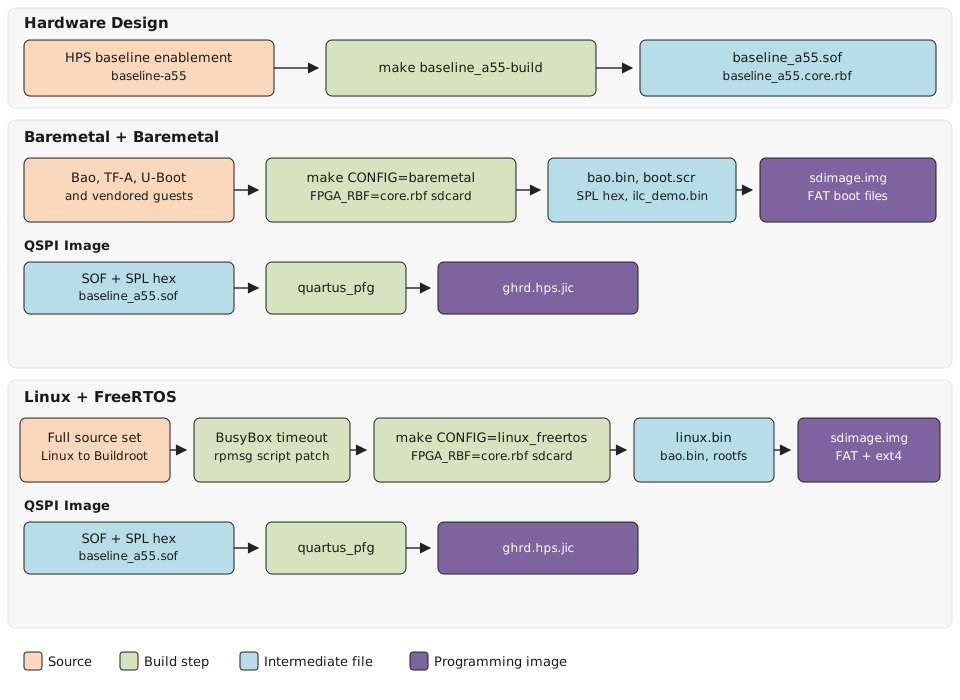
make baseline_a55-build writes baseline_a55.sof and baseline_a55.core.rbf. Pass that core RBF as FPGA_RBF. The SD card step stores it on the FAT partition as fpga.rbf. boot.scr programs the fabric from that file and enables the HPS-to-FPGA bridges before it jumps to Bao, which is what makes the ILC registers at 0x20000000 reachable.
make CONFIG=baremetal FPGA_RBF=... sdcard fetches Bao, Trusted Firmware-A, and U-Boot. It builds VM1 and VM2 from bao-baremetal-guest/, links both images into bao.bin, builds ilc_demo.bin, compiles configs/baremetal/boot.cmd into boot.scr, and writes a FAT-only sdimage.img. quartus_pfg then combines baseline_a55.sof with that configuration's u-boot-spl-dtb.hex into build/baremetal/out/ghrd.hps.jic.
make CONFIG=linux_freertos FPGA_RBF=... sdcard fetches the full set. It builds Linux and wraps the Image plus configs/linux_freertos/linux.dts into linux.bin with the lloader stub, builds the FreeRTOS rpmsg_console guest and links it into bao.bin, and builds a Buildroot ext4 root filesystem. The SD image carries the FAT boot partition and that root filesystem. The steps below add a BusyBox timeout applet and a small fix to rpmsg-bidir-check.sh before this build, so the check script in the run section is on the root filesystem. quartus_pfg writes a separate JIC under build/linux_freertos/out/ that contains this configuration's U-Boot SPL.
Each configuration writes its own JIC and SD card image. Program the pair for the configuration you want to boot.
Setup Build Environment
Create a top folder for the example:
sudo rm -rf agilex5_065b_pdk.amp_bao
mkdir agilex5_065b_pdk.amp_bao
cd agilex5_065b_pdk.amp_bao
export TOP_FOLDER=`pwd`
Enable Quartus tools to be called from command line:
Build Quartus Design
Get the example design files and build the hardware design:
cd $TOP_FOLDER
rm -rf agilex5_soc_devkit_ghrd && mkdir agilex5_soc_devkit_ghrd && cd agilex5_soc_devkit_ghrd
wget https://github.com/altera-fpga/agilex5-ed-hps-baseline/releases/download/QPDS26.3_REL_BASELINE_PR/dk-a5e065ab32aea-enablement-baseline-a55.zip
unzip dk-a5e065ab32aea-enablement-baseline-a55.zip
rm -f dk-a5e065ab32aea-enablement-baseline-a55.zip
make baseline_a55-build
The following files are created:
$TOP_FOLDER/agilex5_soc_devkit_ghrd/output_files/baseline_a55.sof
Build AMP Bao Baremetal+Baremetal Example
1. Go to AMP Bao examples folder:
2. Build example software, including the SD card image
This will create the following relevant files:
build/baremetal/out/sdimage.imgbuild/baremetal/out/u-boot-spl-dtb.hex
3. Create the QSPI flash image:
quartus_pfg \
    -c ../../output_files/baseline_a55.sof \
    build/baremetal/out/ghrd.jic \
    -o device=MT25QU128 \
    -o flash_loader=A5ED065AB32AE1V \
    -o hps_path=build/baremetal/out/u-boot-spl-dtb.hex \
    -o mode=ASX4 \
    -o hps=1
This will create the following file:
build/baremetal/out/ghrd.hps.jic
Build AMP Bao Linux+FreeRTOS Example
1. Go to AMP Bao examples folder
2. Add timeout package to buildroot instructions, to work around a rpmsg script issue:
echo 'CONFIG_TIMEOUT=y' > buildroot/configs/busybox-timeout.fragment
echo -e '\nBR2_PACKAGE_BUSYBOX_CONFIG_FRAGMENT_FILES="../configs/busybox-timeout.fragment"' >> buildroot/configs/aarch64.config
3. Fix an issue with the rpmsg script
base64 -d <<'EOF' | gunzip > rpmsg-bidir-check.patch
H4sIAAAAAAACA51Ta2+bSBT9Pr/ilLVcEMYYP1KlCd6msh1ZSpOVE20qtd0Iw2CuQhlrGGJHbf97
ZyDOa7tdtXyxmbn3cO455yaUpvC8FSlEfk5FtfWlECotPXHDZR7d+lUp/SUVvlx/LlfekhKSXpzx
+LpbZlj+eg+jIuFbjPbjUX+w1+2OhlG8DHoIer294ZB5nvc7TJjrur/F5s0beP39TtCHa36G0AeU
4gNewIthtSbTvy18OoDKeMFgHr7VYgUMKTEwl295jMHhuKlkLsMfmMiICkTFrcqoWCHKJY+SW6x5
kZh3fafRUNOBNCd6ZqGP5IZKrvsg8sTgZDySaskjhThaq0ryBEueCsmx4Sh5ocw3sNYIJTaiyhOU
13zTgG+9hOcq6jLPhqLPXFSatMZRu5nGfsJv/KLKc/TH7QAOvn6FkhVn7vOOw/bgJ+UwVBd6Qi5f
74iiWkMJXM5PJ2eXV+cQ6aNhlIzSlOIn1KzWrtZ6QlL/OTk7nlm7j7Yfs3veVPP8dwcW06PJdHH1
13wStl40fI/phjdC1cRflhDaHrvv1OCGu05Mggip5Drn2rm1oFrwBDlXEAWvozPc7+zBHQWdVyY4
i/dXb6ezs8U0bNnR5hov/X8+fpgtLj5+QraEjy+syZbVuq+0EMJ6Nz8/n58ePwvaNWmxdek9ezPT
vQ1NzSYi9ZMatwmsiei47d3lN84ErNnR/OQ1CvGjkOmApiRLbX8fpQnnTHK+uDg7R1YVqz+1Le1+
g9VY1eh9f3i3IEae0at6s/Z6nWBgBDI7Q2GPYZNRzmslyIKXG5TTevxENCCkJbQJLgLHYd4Db5P2
K9M0xm7lfnTZHjANVdyl89KopBfnkePG4pQK0uaSKh+SustWKcySrbTVusdgHM0uposHtezS6bL/
lf+R9Mykowb573CYx9C0KQwO6DA8nR2Q6zomNHZZLUsl7RZ1gs7ACUNLbkPLwRfoC7t+6VhWp0XO
AW7CFuEb+w6g4+tU3AUAAA==
EOF
patch -p1 < rpmsg-bidir-check.patch
4. Build example software, including the SD card image:
CMAKE_POLICY_VERSION_MINIMUM=3.5 \
make CONFIG=linux_freertos \
    FPGA_RBF=../../output_files/baseline_a55.core.rbf \
    sdcard
This will create the following relevant files:
build/linux_freertos/out/sdimage.imgbuild/linux_freertos/out/u-boot-spl-dtb.hex
5. Build the example QSPI image:
quartus_pfg \
    -c ../../output_files/baseline_a55.sof \
    build/linux_freertos/out/ghrd.jic \
    -o device=MT25QU128 \
    -o flash_loader=A5ED065AB32AE1V \
    -o hps_path=build/linux_freertos/out/u-boot-spl-dtb.hex \
    -o mode=ASX4 \
    -o hps=1
This will create the following file:
build/linux_freertos/out/ghrd.hps.jic
Run the Examples
Run the Baremetal+Baremetal Example
VM1 prints the [VM1] IPI lines and VM2 prints the [VM2] ILC lines on UART0. The baremetal architecture above is the map of those two streams. boot.scr leaves ilc_demo.bin on the FAT partition. The standalone ILC README has the U-Boot commands that start it at 0xA0000000.
1. Write the SD card image: $TOP_FOLDER/agilex5_soc_devkit_ghrd/software/amp_bao/build/baremetal/out/sdimage.img
2. Write the QSPI flash image: $TOP_FOLDER/agilex5_soc_devkit_ghrd/software/amp_bao/build/baremetal/out/ghrd.hps.jic
3. Power cycle the board.
4. You will see on the serial console the U-Boot SPL and U-Boot booting, Bao loading and running the two baremetal applications:
=== Agilex5 Bao AMP Boot (baremetal) ===
Loading FPGA bitstream (fpga.rbf, if present)...
switch to partitions #0, OK
mmc0 is current device
1593344 bytes read in 27 ms (56.3 MiB/s)
..FPGA reconfiguration OK!
Loading Bao hypervisor (bao.bin)...
299008 bytes read in 13 ms (21.9 MiB/s)
Booting Bao hypervisor...
## Starting application at 0x90200000 ...
Bao Hypervisor
BAO INFO: smmuv3: enabled, 256 stream-table entries, coherent table walks
*** [VM1] — UART printer
[VM1] printer ready
*** [VM2] — ILC worker
[VM2] ILC init done
[VM1] IPI n=5 | min=2645 max=6300 avg=3539 ns
[VM2] ILC n=5 | min=1680 max=3590 avg=2236 ns
[VM2] ILC n=10 | min=1680 max=3590 avg=2089 ns
[VM1] IPI n=10 | min=2522 max=6300 avg=3110 ns
[VM2] ILC n=15 | min=1680 max=3590 avg=2040 ns
[VM1] IPI n=15 | min=2522 max=6300 avg=2971 ns
[VM2] ILC n=20 | min=1680 max=3590 avg=2014 ns
[VM1] IPI n=20 | min=2522 max=6300 avg=2902 ns
[VM2] ILC n=25 | min=1680 max=3590 avg=2000 ns
[VM1] IPI n=25 | min=2522 max=6300 avg=2856 ns
...
Run the Linux+FreeRTOS Example
Bao has already started FreeRTOS when the login banner appears. echo start attaches bao-rproc to that guest. Heartbeats and ILC lines arrive on /dev/rpmsg0. The shared-memory layout is in the Linux and FreeRTOS architecture above.
1. Write the SD card image: $TOP_FOLDER/agilex5_soc_devkit_ghrd/software/amp_bao/build/linux_freertos/out/sdimage.img
2. Write the QSPI flash image: $TOP_FOLDER/agilex5_soc_devkit_ghrd/software/amp_bao/build/linux_freertos/out/ghrd.hps.jic
3. Power cycle the board.
4. You will see on the serial console the U-Boot SPL and U-Boot booting, then Bao loading Linux:
=== Agilex5 Bao AMP Boot ===
Loading FPGA bitstream (fpga.rbf, if present)...
switch to partitions #0, OK
mmc0 is current device
1593344 bytes read in 27 ms (56.3 MiB/s)
..FPGA reconfiguration OK!
Loading Linux+FreeRTOS binaries...
42527232 bytes read in 508 ms (79.8 MiB/s)
1155080 bytes read in 28 ms (39.3 MiB/s)
Booting Bao hypervisor...
## Starting application at 0xE0000000 ...
Bao Hypervisor
BAO INFO: smmuv3: enabled, 256 stream-table entries, coherent table walksBAO INFO: smmuv3: stream 5 -> stage-2 (vmid 0, s2ttb 0x85264000)BAO INFO: smmuv3: stream 3 -> stage-2 (vmid 0, s2ttb 0x85264000)BAO INFO: smmuv3: stream 7 -> stage-2 (vmid 0, s2ttb 0x85264000)[    0.000000] Booting Linux on physical CPU 0x0000000000 [0x414fd0b1]
5. When prompted, log into Linux using 'root' as username. No password will be required:
6. Attach remoteproc (bao-rproc probes as detached; auto_boot is false)
# echo start > /sys/class/remoteproc/remoteproc0/state
# cat /sys/class/remoteproc/remoteproc0/state
attached
7. Check the RPMsg char device exists
8. Read from the RPMsg device (stop cat with CTRL-C):
# cat /dev/rpmsg0
[FRT] ilc-init rc=0 intid=50 prio=0
[FRT] hb uptime=15s tx=1 txfail=0 rx=0 last=""
[FRT] ilc n=10 min=2040 max=2360 avg=2120 ns total=10
[FRT] hb uptime=25s tx=2 txfail=0 rx=0 last=""
[FRT] ilc n=10 min=2050 max=2330 avg=2174 ns total=20
...
[FRT] ilc n=10 min=2000 max=2030 avg=2016 ns total=2530
[FRT] hb uptime=2545s tx=254 txfail=0 rx=0 last=""
[FRT] ilc n=10 min=2000 max=2030 avg=2012 ns total=2540
^C
9. Send a message:
10. Check that the message from the previous step has arrived (stop cat with CTRL-C)
# cat /dev/rpmsg0
[FRT] hb uptime=2565s tx=256 txfail=0 rx=1 last="Test Ping"
[FRT] ilc n=10 min=2010 max=2030 avg=2017 ns total=2560
^C
11. Run the automated test script
# /usr/bin/rpmsg-bidir-check.sh
Terminated
rx_before=1 rx_after=4 delta=3 expected=3
--- heartbeat log (/tmp/rpmsg-bidir-check.log) ---
[FRT] hb uptime=2585s tx=258 txfail=0 rx=1 last="Test Ping"
[FRT] hb uptime=2595s tx=259 txfail=0 rx=4 last="ping_3"
[FRT] hb uptime=2605s tx=260 txfail=0 rx=4 last="ping_3"
--- end ---
PASS
#
Notices & Disclaimers
Altera® Corporation technologies may require enabled hardware, software or service activation. No product or component can be absolutely secure. Performance varies by use, configuration and other factors. Your costs and results may vary. You may not use or facilitate the use of this document in connection with any infringement or other legal analysis concerning Altera or Intel products described herein. You agree to grant Altera Corporation a non-exclusive, royalty-free license to any patent claim thereafter drafted which includes subject matter disclosed herein. No license (express or implied, by estoppel or otherwise) to any intellectual property rights is granted by this document, with the sole exception that you may publish an unmodified copy. You may create software implementations based on this document and in compliance with the foregoing that are intended to execute on the Altera or Intel product(s) referenced in this document. No rights are granted to create modifications or derivatives of this document. The products described may contain design defects or errors known as errata which may cause the product to deviate from published specifications. Current characterized errata are available on request. Altera disclaims all express and implied warranties, including without limitation, the implied warranties of merchantability, fitness for a particular purpose, and non-infringement, as well as any warranty arising from course of performance, course of dealing, or usage in trade. You are responsible for safety of the overall system, including compliance with applicable safety-related requirements or standards. © Altera Corporation. Altera, the Altera logo, and other Altera marks are trademarks of Altera Corporation. Other names and brands may be claimed as the property of others.
OpenCL* and the OpenCL* logo are trademarks of Apple Inc. used by permission of the Khronos Group™.